23 August 2026
Tony & Anne's Solar Journey
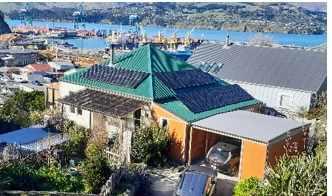
Dublin Street, Lyttelton — two people, retired, living in a 130 square metre house.
What energy do you have in your home?
We have roof-top solar and a storage battery. Cooking and hot water heating are electric. A ULEB wood fire heats the whole house, with a heat pump used very occasionally. We drive an EV and a PHEV which are charged at home.
When did you start, and why?
For many years we have been mindful of our environmental and carbon footprint. In 2018 we purchased a PHEV and after 4 years of use, charging it on night-rates electricity at home, we realised that the savings in petrol costs over this period would have covered the cost of installing a PV solar system. We installed PV panels in late 2022 and also replaced our other car with an EV about this time. A year later we added a 12 kWh house storage battery.
What do you love most about it?
Being nearly energy neutral in our electricity generation and use, albeit this being lopsided between summer and winter use. The cost savings are considerable comparing what we paid in 2022 and what we pay now.
How has it changed your behaviour?
We use as much of the energy that we generate directly from the PV system, with surplus generation charging the battery and, when that is full, sending power to the grid. So our usage tends to be during the day, which is easy for us being home. In winter, we charge the storage battery fully using off-peak night-rates and use this power in the morning peak period until the panels start generating.
We are much more aware of how we use electricity, and at what time of the day. We also seek to reduce our consumption. The battery has enabled us to minimise grid electricity use during the day and peak demand times.
The numbers
Energy use and bills: before (2022) $2,400/year including PHEV charging; after (2025) $600/year including charging a PHEV and EV.
Total energy savings: $6,000/year including electricity and petrol.
Solar system: 6.8 kW, 17 panels, $18,000. Grid-tied system with a 12.0 kWh storage battery, $10,000. Yield: 7,500 kWh/year.
Energy use now: household use 4,500 kWh/year plus EV and PHEV charging 4,000 kWh/year.
Any advice?
Shop around for the best energy deals that suit your use — for example, EV packages can provide longer off-peak night-rate hours.
Check the amount of sun your PV panels would get throughout the year. System suppliers will assess this before recommending a system. Our panels generate 45 kWh of electricity on a clear day in summer, and only 10 kWh on the best day in winter.
EV end-of-life batteries are being repurposed to house storage batteries, including being done locally. Repurposing gives the batteries many more years of use before they need to be dismantled for recycling.
If installing a storage battery, larger is better. We initially installed a 6 kWh battery, but have now doubled this size to 12 kWh. Most batteries are modular and additional capacity can be added.