18 May 2026
LETS Newsletter No 25
Newsletter No.25 May 2026
Committee News

Hi Everyone,
As always there is lots happening at LETS. On June 6th we will be having another Lyttelton Farmers Market Outreach morning from 10-1pm. Pop by if you are interested to find out more. Similarly recommend to your friends and family that we will be there and encourage them to visit if they’d like more information on the energy transition.
We also have a new initiative starting in June. We are going to host a new drop-in at Spooky Boogie on Sunday June 21st between 2-3pm. Our aim is to come to the community and meet you where you are most comfortable. We imagine over the next few months to host these at various places that locals go. We want to make it as easy as possible for you to get answers about how you can change your home energy usage.
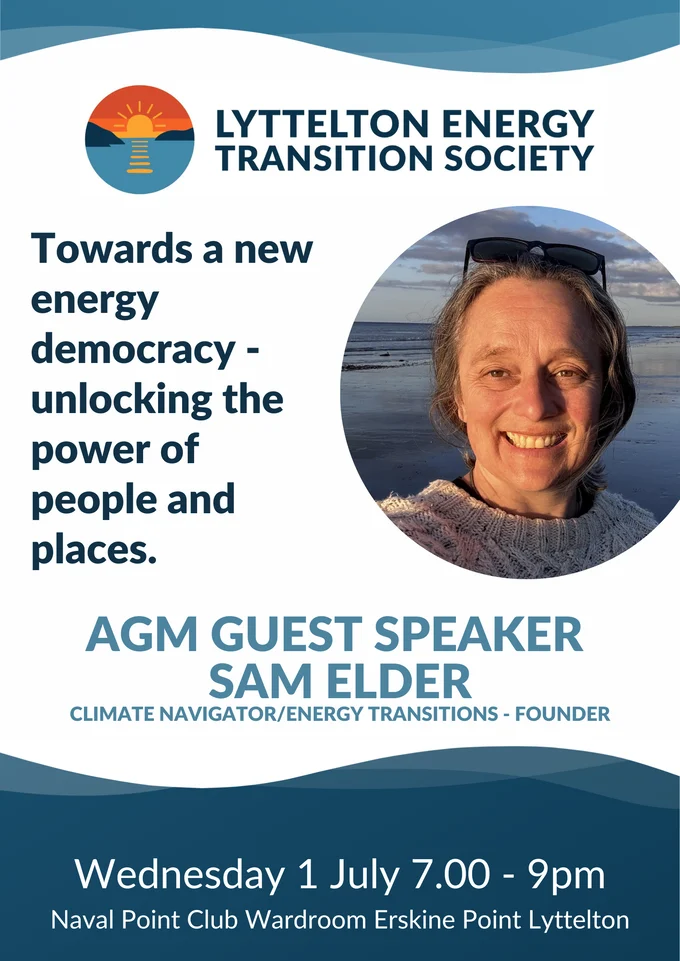
Finally we are giving you plenty of advance notice for our AGM on July 1st at 7pm. We have decided to host this event at a larger event space so will be heading to Naval Point Wardroom for the first time. We are very fortunate to have Sam Elder as our guest speaker. The focus of this event will be to mobilise our community to re-localise energy.
Here is a link to our April Minutesfor all the details on what was discussed
https://drive.google.com/file/d/1gfoSb_8DxuvI_0g2Wwj3dgR0HH8aQtCP/view?usp=sharing
Our next committee meeting will be Monday May 25th at 7pm.Please note our new location is 54A Oxford Street at Project Lyttelton (The Portal) above the Garage Sale.
Look forward to seeing you**at our next events.**
June 6 Visit LET’s at the Farmers Market 10-1pm
June 21 Drop In at Spooky Boogie 2-3pm
July 1**AGM and Guest Speaker Sam Elder 7pm**
Wendy, Sam, Greg, Juliet, Tony, Margarita, Raymond and Dana.
Agency Over Our Energy
The Opportunities for Our Communities
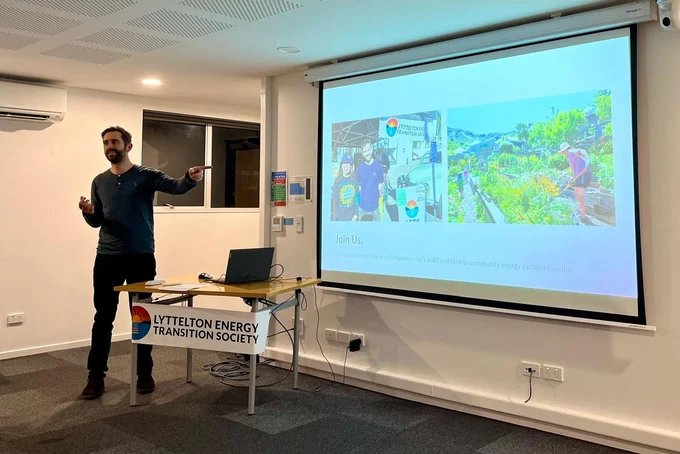
Sam Kivi LETS Co-Chair’s presentation. Photo Credit : Margarita Parra
Sam took the audience through a crash course on how the electricity industry works. From the generators, the national grid, the lines companies down to the household level and then a quick run down on how the market works and how the prices are set.
He described how the system has been developed for security of supply and is optimised to be able to supply power on those days when demand is the highest and that’s the middle of winter early in the morning and in the evenings. He explained that for the majority of time much of the system is underutilised as there is not peak demand all the time.
Still the NZ grid is expanded to meet future demand and more renewable assets are being added to the grid, generating even more electricity. This extra supply however is often wasted because demand does not match supply. He used the example of Australia. During the daytime in summer so much solar is produced that there are not enough customers to use it. That sends the price plummeting and the cost becomes nothing. The available energy is a resource wasted because there are no buyers.
It’s this wasted energy that Sam believes has huge potential for both local communities and business. He believes that if a market can be created for this wasted energy, communities and businesses will get the most out of the electricity assets and this will help us all. His idea evolves around not just time-shifting loads away from peak demand, but also thinking about what valuable uses of the energy can be boosted during periods of surplus renewables. He’d like to see an open source model created to enable households and businesses to shift electric loads easily to other time slots to store and utilise the spare capacity.
Thinking of Lyttelton specifically. He said if 200 homes were encouraged to shift loads of 3kW each at a time when the lines company was experiencing high demand that would free up 600kW. This might be as simple as turning the hot water heating or spa pools off for a couple of hours and users would not be inconvenienced at all. Such an orchestrated system is now a realistic goal for a community such as Lyttelton to develop with the availability of low cost control and monitoring software and hardware. Our local lines company Orion is interested in this idea and have indicated they would be happy to incentivise load shifting when required as it helps them manage their network more efficiently.
Sam also spoke about his company Grid Share. They have sought to solve this wasted energy utilisation problem and found an unlikely ally - computing - a uniquely flexible load. When electricity prices are low, signalling there is too much supply, Grid Share switches the computing function on. Money earned from the computing operation provides income for Grid Share and the site partner. As the cost of power increases past the break even point the computing function is turned off and the renewable resources are freed up to supply the peak demand, still earning money from its generation export. The key to community benefit is choosing computing services that don’t compete on energy cost, and empowering the community to maintain control of the operation. Using power when it is abundant and cheap also helps stabilise a grid that is supplied by intermittent solar and wind power. This boosts utilisation of infrastructure, lowering fixed costs and encouraging more renewable development.
Similarly another by-product of computing is heat. This heat can also be sold to nearby businesses for example to heat water radiators in agricultural green houses. Sam mentioned that in 2024 at the Paris Olympics the main pool was heated by computing generated heat!
His message to our community is that when we develop our community energy systems, let's think also about the potential to capitalise on the waste product as well as the electricity production. For example if we had a computing function at Project Lyttelton, the heat generated could be shared to heat the Lyttelton Pool. Also when we add batteries to our community systems the opportunities for flex sharing becomes even more of a reality. Our communities could own the power, the heat, the revenue and the know how. LETS intends to experiment and demonstrate these ideas on our newly establishing community solar system at Project Lyttelton. This is a wonderful opportunity awaiting local energy systems for both businesses and communities.
We the Power
What an inspiring community energy documentary. Communities literally taking back the power from the large centralised energy companies. Energy poverty is an issue all over the world and this documentary showed what communities in Europe are doing to change this. Many communities believe community ownership of the energy assets is the solution. Their premise is when the community owns the assets the money earned from electricity generation stays with the community. People have “skin in the game”. Communities even get to like wind turbines when the benefits of the local generation stays with the community!
At the time of the documentary’s production there were over 1,500 community energy cooperatives in Europe sharing power with local people!
Harbour Co Op is Lyttelton’s only community-owned co-operative: owned by 215 households, employees, and 3 institutional purchaser organisations, maybe LETS can become the second with a community energy co-operative?
If you missed the film night we recommend you watch the YouTube for inspiration.
Communities in New Zealand are slowly adopting this approach as well. 350.0rghas just released a local community energy video showing what Energise Ōtaki and Raglan communities have been doing.
Got questions about Solar, EV’s, Electric Appliances?

Come and join some LET’’s committee members over a coffee/tea at Spooky Boogie on Sunday June 21st between 2-3pm. We’ll be located in the back room. This is your chance to ask all those questions that you have been saving up about electrification with trusted locals who should be able to point you in the right direction. As a bonus incentive to visit have a cup of delicious Spooky Boogie coffee on LETS.
Explaining the proposed reform by the Electricity Authority for pricing distributed generation in New Zealand
The Electricity Authority - Te Mana Hiko is proposing to reform the pricing methodologies for distributed generation—which includes things like rooftop solar, home batteries, bidirectional electric vehicles, or even small local power plants. The goal of the reform is to make sure distributed generation is built in the right places, at the right times, and at the lowest overall cost for all Kiwis.
The reform includes a review of the balance of the charges between supply and purchase of electricity in order to inform prices (the Authority refers to these as injection and offtake of electricity). Distributed generators (in other words, the users or owners of rooftop solar, home batteries, or EVs with bidirectional capabilities) are financially rewarded to supply electricity, but they could also be charged if they incur new grid costs. With the good news that the reward payment would be higher when the injection helps alleviate network congestion or peak events, which are costly for the lines companies.
From the point of view of the distributed generator (DG), the final payment in the bill (the net benefit) depends on this simplified equation: Net benefits = Sum of all Costs - Sum of all Benefits. Now, one important part of the reform is that the costs and benefits are going to be localised and temporalised. It is not the same to add electrons into a local transformer if you are the only DG in the block or if there is already congestion in the network. It is not the same to supply electricity from a very low cost (solar) when the system is getting electricity from the higher costs (thermal generation at winter peak, for example).
In terms of costs, it is true that there are always costs to the network for using its infrastructure in both directions:supply and purchase. However, there are costs that increase with more injection: network maintenance, congestion management, complex operation, and voltage control. If the local existing infrastructure can't handle the supply from DGs and there is a need for more transformers, wires or poles or other pieces of software equipment, there will be costs for these upgrades.
The reform presents an alternative proposal to recover those costs in a fair way. The Authority proposes that the marginal costs—all those new costs—be recovered not by the user/DG that happens to get over the existing capacity (our "first mover") but be distributed among all future users/DGs who are beneficiaries. They propose to use a pioneer scheme with a rebate mechanism to incentivise people.
In terms of benefits, we know already that having solar on the roof produces actual monetary savings. At LETS, we have the stories of Wendy and Tony published on our website showing the benefits in their electricity bills. With this new methodology, they may see increased benefits if their supply to the network coincides with peak events or at times of strain to the network These are substantial gains. In the long run, the Net Benefits from the supply from DGs at the right time and at the right place will be high enough that it will defer investments into new network infrastructure. This means with more distributed generation, we can lower electricity costs for everyone, not just for the ones who are able to get rooftop solar, batteries, and bidirectional EVs. Furthermore, by providing more equitable compensation as an incentive, we can increase distributed generation across the motu.
For LETS, we are paying attention to how this reform will impact our existing community projects and how it could shape the potential energy exchange (imports and exports) that could happen among projects at community level. In Lyttelton we are working to install solar in Project Lyttelton’s building and to improve the existing solar installation at Lyttelton Primary School. Community projects with distributed generation have greater impact because the benefits can be extended to the wider community and neighbours, and support overall energy affordability and resilience.
If you want to find out more about the proposal, visit the Electricity Authority’s page.
The consultation is open and receiving input until May 19th. Please note that’s tomorrow.
Written by Margarita Parra - LETS committee member and just-energy-transition enthusiast.
Time to Renew Your Membership

Photo Credit: rawpixel.com on Freepik
It’s the start of our new membership year. Thank you all so much for supporting LETS on our journey so far. At our AGM last year we resolved that the membership fee would increase to $20 per member with the option of $5 according to your means.
For those of you who haven’t renewed your membership yet please send your membership renewal and any donations to our Kiwibank account
Lyttelton Energy Transition Society 38-9025-0680672-00 Reference Membership LETS and your name.
Your membership fees and your generous donations help support our administrative overheads. All of your donations are tax deductible and will be receipted.
Thank you all.
Dates for your Diary
Events coming up:
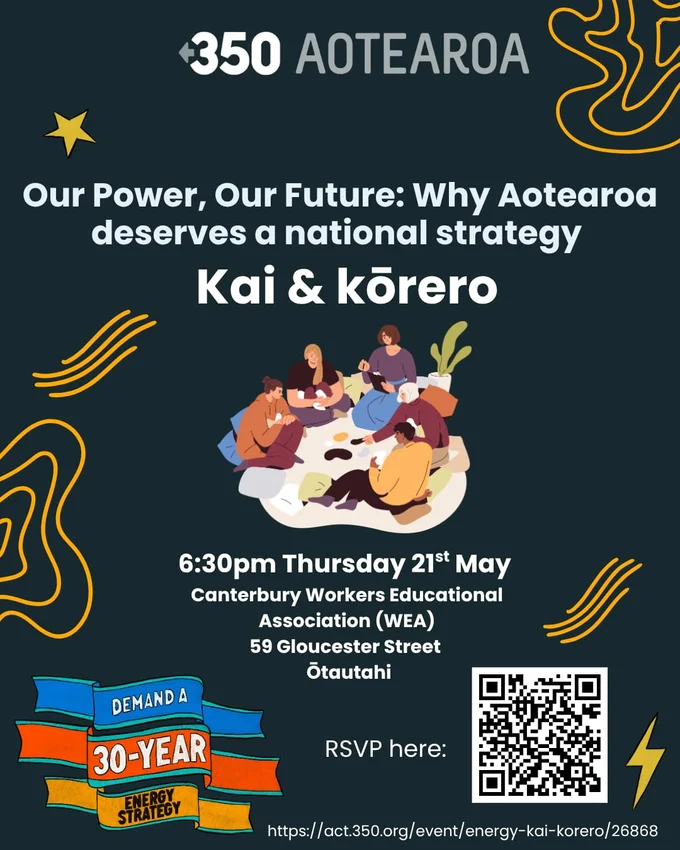
May 21 350.org Energy Conversation
May 25 Committee Meeting 7pm
June 6 Visit LETS at the Farmers Market 10-1pm
June 21 Drop In at Spooky Boogie 2-3pm
June 22 Committee Meeting 7pm
July 1AGM and Guest Speaker Sam Elder 7pm
Membership
If you would like to join LETS and haven’t yet, here is a link to our membership application
It’s very affordable, only $20 or $5 unwaged and you’ll be helping to shape the future of Community Energy in Aoteroa. Donations are also gratefully accepted and are tax deductible. Thank you.

All members are welcome to sign up to our LETS Whats App Group. In this group we share networking opportunities and informative articles/podcasts. If you are interested please text Wendy 021 0476144.
Facebook Lyttelton Energy Transition Society -LETS
For links to our web page and email please click on the links at the bottom of the newsletter.
Do you have any news or events energy related that you’d like included in this monthly broadcast? Please email Wendy communityenergylytt@gmail.com
If you're reading this online and want it delivered to your inbox, click on the 'Subscribe' link in the top LH of this newsletter (if you're reading it on a screen), subscribe here,or email me at communityenergylytt@gmail.com